01 / UNDERSTAND
What is a five second test?
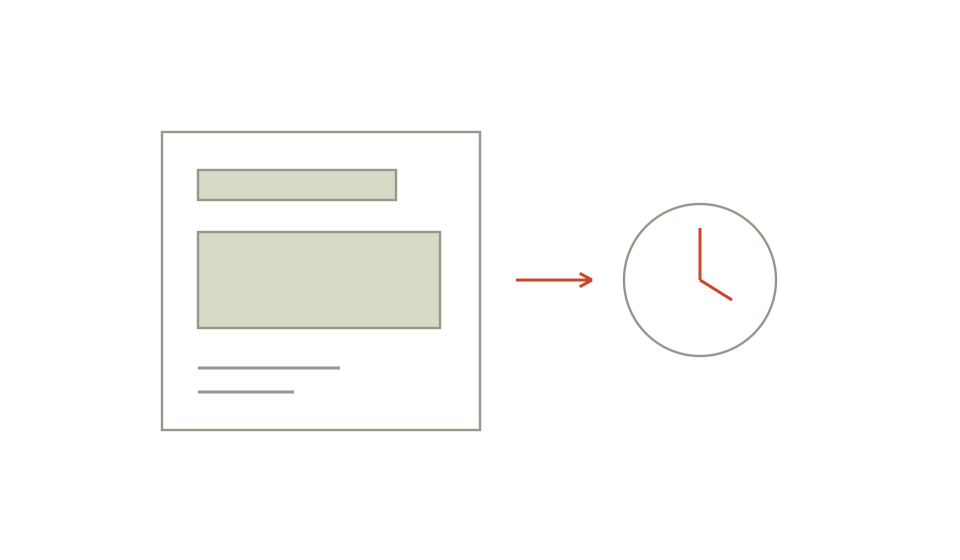
A five second test briefly shows a visual, removes it and asks what the person remembers or understood. It examines immediate message uptake and hierarchy under a deliberately short exposure. It is a test condition, not a universal rule about human attention.
The method can help with an opening screen or campaign visual. It cannot establish whether a person can complete a task, understand a long document or use the design successfully over time.
Why use 5-Second Test?
A carefully written message can be technically present and still fail to register. Brief recall exposes what people actually take away before detailed reading. For a designer, the value is a more focused question about message priority, not a verdict that anything missed in five seconds should be deleted.
When to use it
USE IT WHEN
A visual must convey its purpose quickly.
The team wants to examine an opening hierarchy before deeper testing.
Different messages may compete for early attention.
When to choose another method
Use First-Click Testing to inspect where people would begin a task.
Use Usability Testing to examine actual completion.
Use User Interviews when understanding depends on a wider context of need.
What you’ll need
Prepare a realistic crop and device size with genuine text. Decide what should register and write neutral recall questions before exposure. Recruit people relevant to the audience and do not prime them with the exact message being tested. Check timing, loading and image visibility in a pilot. Record conditions so later rounds compare equivalent exposure.
What a first impression test contains
Keep the elements that help answer your question and support a decision.
The actual screen or material at a realistic size.
Audience and neutral viewing situation.
The declared five second viewing interval.
Prompts about meaning and remembered elements.
A predeclared interpretation of accurate, partial and incorrect recall.
The communication change and fuller test needed afterward.
02 / PUT IT INTO PRACTICE
How to run a five second test
Keep evidence and assumptions distinct. Revisit your work when new information changes your understanding.
01
Define intended uptake
Choose the important idea that should register quickly.
A repair subscription includes planned maintenance, not emergency cover.
02
Prepare the visual
Use realistic copy, crop and device proportions.
Do not compare a polished full desktop page with a cropped mobile sketch.
03
Write neutral prompts
Ask what the visual was for without giving the answer in the introduction.
Avoid telling people this is an emergency repair service.
04
Pilot exposure
Check that the image is fully visible for the stated interval and then removed.
Loading time should not consume the exposure.
05
Collect recall
Ask concise questions immediately, before showing the image again.
What do you think this service offers?
06
Review meaning
Code responses against the intended message and retain unexpected interpretations.
Remembering repair is not the same as understanding nonemergency coverage.
07
Revise and test further
Adjust hierarchy or wording, then examine fuller use where needed.
Test comprehension during signup before calling the offer clear.
Example: first impressions of a repair subscription page
Fictional scenario: an opening screen says Planned home repairs but a large urgent looking icon dominates the visual. After a five second exposure, illustrative responses describe emergency repair cover and immediate attendance. Other responses correctly recall scheduled maintenance.
The example places the tested visual concept beside three recall cards: intended meaning, remembered meaning and unresolved question. No response counts are presented as research results.
The proposed change is to bring the coverage boundary into the main message. The team would retest brief uptake and then examine whether people understand the exclusions when making a subscription decision. A better first impression alone would not establish informed signup.

03 / BELOW THE SURFACE
Below the surface: recall rewards salience, not necessarily truth
A memorable message can be the wrong message for the decision a person must make.
ACCURACY
Is the remembered idea actually true?
Separate literal content from inference.
DECISION
What later understanding does the person need?
Brief recall cannot prove informed choice.
CONDITIONS
Who needs a different reading context?
Do not universalise the exposure condition.
An urgent icon might be remembered perfectly while implying availability the service cannot provide. Optimising recall alone would make that misleading signal more effective. The important distinction is whether what registers supports a correct expectation.
For each recalled idea, compare three things: what was shown, what was inferred and what the service can actually promise. Improve the accuracy of the impression, not only its strength. An accurate but incomplete first impression may be acceptable if later information clearly supports the consequential choice.
This editorial review also asks whose reading conditions are absent. Short exposure should not become a reason to penalise designs intended for careful reading or people who need more time. Pair it with appropriate task and comprehension testing.
5-Second Test companion worksheet
The original companion documents the exposure, intended message, questions and recall categories. Page two checks inferred promises and the next comprehension test. Attach the tested visual separately and keep its version and crop identifiable.


Practical tips
Use real text and realistic display proportions.
Avoid revealing the desired answer before exposure.
Preserve incorrect interpretations instead of recoding them generously.
Common mistakes
Claiming people always decide in five seconds.
Using recall as proof of usability.
Making an inaccurate message more prominent because it is memorable.
What you’ll get
A focused account of immediate message uptake under a stated condition. Use it to improve hierarchy or wording, then verify the understanding needed for real use and consequential decisions.