
01 / UNDERSTAND
What is a think aloud protocol?
A think aloud protocol asks participants to express thoughts while attempting tasks. The researcher observes what happens and listens for expectations, interpretations and uncertainty. Speech is evidence about the reported experience, rather than a complete transcript of cognition.
Concurrent thinking aloud happens during the task. Retrospective reporting happens afterwards, sometimes with a recording as a cue. The latter reduces interference with task performance but introduces recall limitations. Choose the approach deliberately and record it so readers understand the evidence.
Why use Think-Aloud Protocol?
A click or hesitation is ambiguous. Hearing an expectation helps distinguish unclear language, unexpected responses and missing knowledge. It suggests an explanation to investigate without establishing how common the problem is.
When to use it
USE IT WHEN
A team needs to understand how people interpret language, controls or feedback.
Observed task behaviour is difficult to explain from interaction records alone.
A prototype is ready for realistic tasks and the team can act on identified problems.
When to choose another method
Use User Interviews to explore experiences outside the session.
Use First Click Testing for initial navigation choices.
Use A/B Testing to estimate a deployed change’s effect.
What you’ll need
Define the question and recruit relevant participants. Prepare neutral scenarios, consent and recording or notes. Plan assistance and interruptions, then pilot with a practice task. Offer suitable communication arrangements; continuous speech does not suit every person or activity.
What to prepare and record
Keep the elements that help answer your question and support a decision.
A realistic goal without instructions that reveal the interface solution.
A consistent invitation to share thoughts and an agreed prompting approach.
Actions, visible outcomes and relevant context recorded separately.
The participant’s words, with time and surrounding interaction preserved.
Every hint, clarification or rescue that may have changed behaviour.
A traceable explanation with alternative accounts and confidence stated.
02 / PUT IT INTO PRACTICE
How to run a think aloud session
Keep evidence and assumptions distinct. Revisit your work when new information changes your understanding.
01
Focus the question
Choose decisions that expressed expectations could inform. Recruit relevant participants.
Investigate expectations after submitting a return request.
02
Prepare the task
Describe a realistic goal without revealing controls. Define starting state and completion.
Ask someone to return an unsuitable item.
03
Introduce the protocol
Explain the session and practise reporting thoughts on an unrelated activity.
Invite fragments and uncertainty, not polished explanations.
04
Observe and listen
Allow action without coaching. Use a consistent neutral reminder when needed.
Leave room for silence. Reading and concentration can require pauses.
05
Record interventions
Timestamp prompts, assistance, clarification and technical failures.
Success after a hint remains assisted.
06
Clarify afterwards
Ask about selected moments without presenting your interpretation as the answer.
Label later explanations as retrospective accounts.
07
Analyse evidence
Connect actions, words and outcomes. Consider competing explanations and choose an investigation.
Test whether clearer status information addresses the incident.
Example: understanding a return acknowledgement
Fictional scenario: a retailer tests a return prototype. After submitting, a participant sees “Your request has been received” and expects a courier to arrive. The next screen actually requires choosing a collection method.
The observer records the message, expectation and attempted exit. The moderator allows continuation, then asks what the participant expected. Immediate and retrospective reports remain distinct.
The team would investigate whether the acknowledgement implies a completed arrangement and test clearer status information. It would not generalise this expectation to all customers. The behaviour and response are invented.

03 / BELOW THE SURFACE
Below the surface: richer speech can produce weaker evidence
The moderator’s desire for explanation can change the activity being studied.
EXPECTATION
What did the person expect next?
Link their words to the exact interface state.
INFLUENCE
What did our intervention change?
Mark evidence gathered after help or prompting.
ALTERNATIVE
What else could explain this moment?
Keep a plausible competing interpretation.
Requests to justify every choice can turn use into explanation. Participants may seek acceptable reasons or become unusually deliberate. Articulate reporting does not automatically mean faithful observation.
“Why did you ignore the collection options?” embeds judgement and interpretation. A later neutral question about expectations preserves uncertainty. Mark where prompting shaped evidence.
Contradictions are useful. Someone may describe a process as clear while repeatedly recovering from errors. Neither observation cancels the other. Investigate how they judged the experience and what their behaviour shows.
Keep incidents tied to starting knowledge. Confusion about unfamiliar service rules may suggest a different intervention from confusion caused by a misleading control.
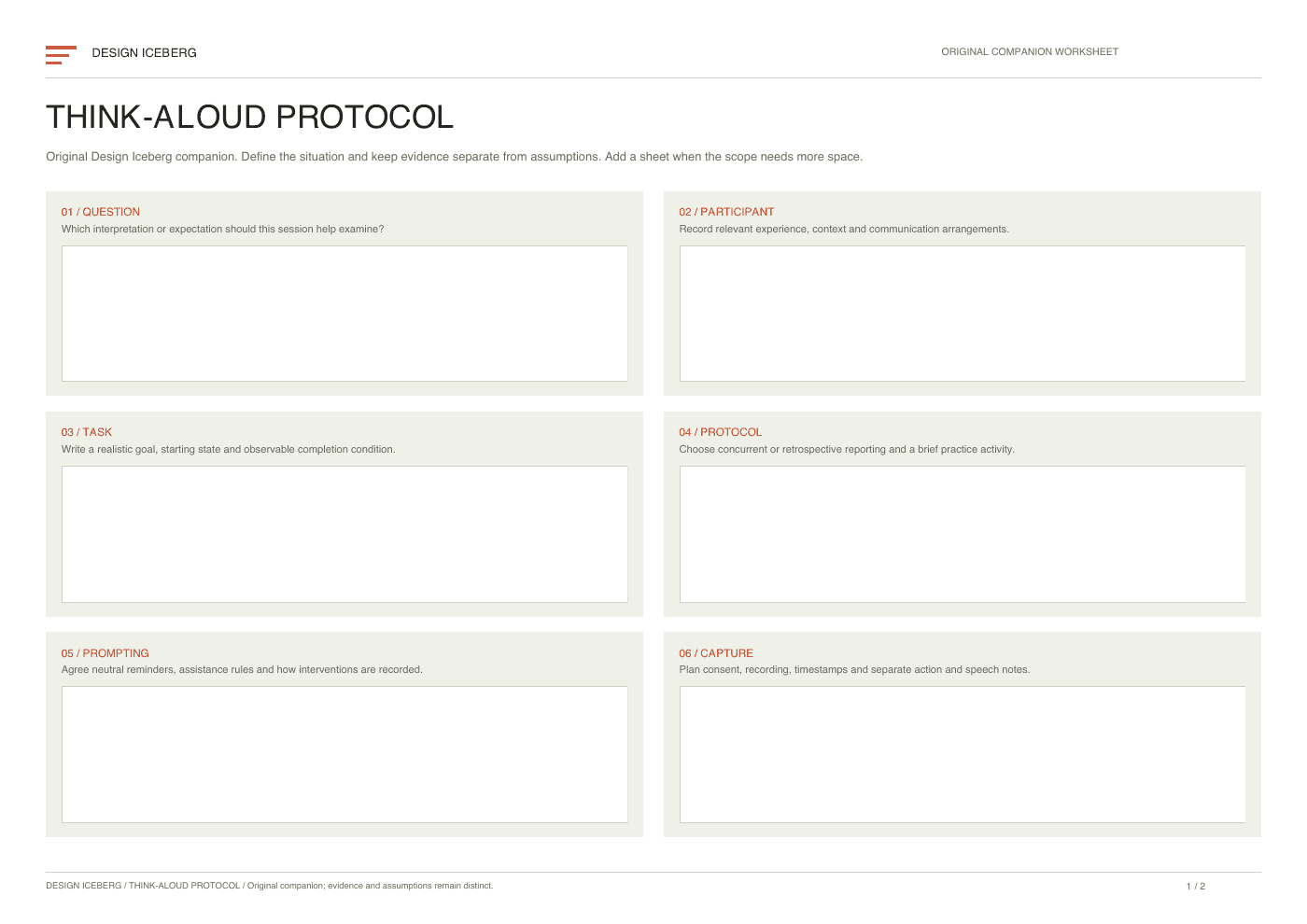
Think-Aloud Protocol companion worksheet
The original two page worksheet provides a session plan and incident review. It connects tasks and prompting rules with actions, verbal reports, interventions and a design question.

Practical tips
Use the same neutral reminder across sessions.
Record speech and observed actions in separate columns.
Review interpretation against the original incident.
Common mistakes
Treating silence as proof that someone is confused.
Asking participants to explain every click while measuring natural performance.
Turning one vivid quote into a claim about all users.
What you’ll get
A set of traceable incidents and plausible explanations. Carry the uncertainty into the next design test, with a clear account of what the participant did, said and received from the moderator.