
01 / UNDERSTAND
What is Customer Effort Score?
Customer Effort Score measures how easy or effortful people report a service interaction to have been. It is often collected after resolving a problem, fulfilling a request or completing a transaction. CES measures perceived effort, not elapsed time or observed task success.
Different versions use different wording, scales and score directions. Select one version, document it and keep it stable. A high score can mean easier or harder depending on the instrument; there is no meaningful comparison without that definition.
Why use Customer Effort Score (CES)?
A service can complete the requested work while forcing people to repeat information, switch channels or coordinate several organisations. Effort feedback can make that burden visible. For a designer, its value lies in locating the work customers had to perform, rather than making every interaction shorter or interpreting one number as the full quality of a relationship.
When to use it
USE IT WHEN
An interaction has reached a point where people can judge the work required.
Repeated contact or channel switching may be creating avoidable burden.
The team can connect ratings with optional explanations and operational evidence.
When to choose another method
Use Time on Task to measure elapsed task duration.
Use Task Success Rate to assess observed completion.
Use Customer Journey Map when effort is spread across many interactions.
What you’ll need
Define whether the question covers one contact or the whole request. Choose clear response labels and state score direction. Plan invitations consistently, including unresolved interactions where appropriate. Record response coverage and avoid collecting only the people who reached the easiest route. Keep an optional explanation about what made the interaction easy or difficult.
What a useful effort measure contains
Keep the elements that help answer your question and support a decision.
The contact, request or journey being rated.
Exact wording and what respondents should judge.
Labels and whether higher means easier or harder.
Who is invited and whose effort remains absent.
Valid responses by category and declared summary.
Reasons, channel changes and repeated information.
02 / PUT IT INTO PRACTICE
How to measure customer effort
Keep evidence and assumptions distinct. Revisit your work when new information changes your understanding.
01
Name the effort boundary
Specify the whole interaction people should consider.
Resolving a repair request includes the calls after the first form.
02
Choose a version
Keep wording, scale and score direction consistent.
Use an ease scale with higher ratings meaning easier, and label that rule.
03
Place the invitation
Ask when people can assess the intended boundary without implying resolution prematurely.
A closed ticket may not mean the resident’s problem is solved.
04
Record coverage
Show eligible invitations, valid responses and unresolved cases.
People still waiting may experience the most work.
05
Summarise transparently
Report the distribution and explain any mean or top category calculation.
Do not convert a seven point mean into an unexplained percentage.
06
Trace the work
Read reasons and follow one difficult account through channels and handovers.
Repeatedly describing the leak may be more burdensome than filling the form.
07
Select a response
Remove unnecessary work while checking completion, trust and staff consequences.
Share information across the handover rather than only simplifying the first screen.
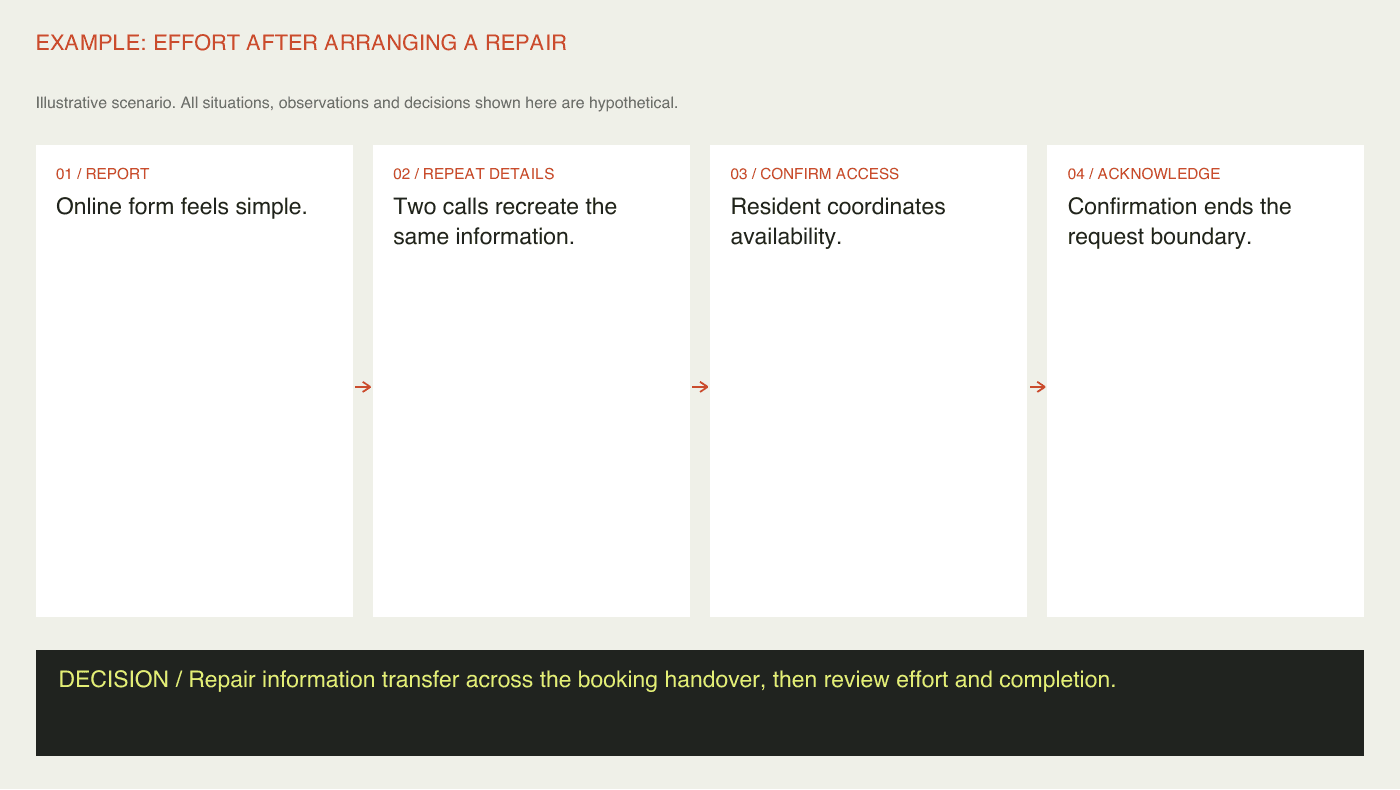
Example: effort after arranging a repair
Fictional scenario: the team uses a seven point ease rating, with seven meaning easiest, for the whole booking request. Twenty respondents give a total of 100 rating points, so the declared mean is 5.0 out of seven. This invented mean is not a universal CES benchmark.
Some accounts describe a simple online form followed by two calls to confirm access. Others describe one staff assisted booking that required little personal coordination. The same digital completion event hides different amounts of work.
The example pairs the rating with an effort path: report, repeat details, confirm access and wait for acknowledgement. The proposed response is to repair the handover, not assume that fewer form fields will address the whole burden.
03 / BELOW THE SURFACE
Below the surface: effort can move without disappearing
An easy customer interaction can depend on difficult invisible work by another person.
BOUNDARY
Was the whole request considered?
Avoid mistaking one easy contact for an easy journey.
TRANSFER
Who now performs the removed work?
Trace staff and informal coordination.
RELIABILITY
What happens without the usual helpful person?
Check the handover under ordinary pressure.
A staff member may make the service feel effortless by copying data between systems or calling several contractors. Removing visible customer work can be worthwhile, but the score does not show whether the resulting arrangement is sustainable.
Trace one high effort and one low effort account through the people who complete the request. Ask which work was removed, which was automated and which was transferred. A lower customer burden should not make recovery ownership disappear. Staff evidence belongs beside customer feedback when the intervention changes a handover.
This is an editorial reading of effort across a service, not a separate scoring framework. Use Service Blueprint to expose the supporting work and test whether the proposed improvement remains reliable when the usual helpful coordinator is unavailable.
Customer Effort Score (CES) companion worksheet
The original two page companion records the chosen CES version, invitation, distribution and work accounts. Page two traces where effort is removed or transferred and defines a review. It does not reproduce a proprietary survey instrument or assert one universal CES formula.


Practical tips
Label score direction every time.
Invite at the end of the intended experience boundary.
Pair a rating with a specific account of the work.
Common mistakes
Comparing scales whose directions differ.
Rating one contact and reporting whole journey effort.
Moving work to staff without checking capacity or recovery.
What you’ll get
A defined perceived effort signal and a concrete burden to investigate. Use it with completion and operational evidence to choose a change that reduces work without weakening the service.