01 / UNDERSTAND
What is churn analysis?
Churn analysis examines who stops an ongoing customer relationship, when they leave and what may explain that departure. It combines a clearly defined loss measure with evidence about the experience before and after exit. Cancellation, inactivity and lost revenue are different events.
For a simple fixed starting population, customer churn is lost customers from that population divided by its starting size. Analytics products may use different conventions; confirm their definition before comparing reports.
Why use Churn Analysis?
A cancellation total offers little direction to a designer. Some people leave because a need ended; others never reached value, cannot afford renewal or encounter a failed payment. Separating these situations avoids responding to every departure with more reminders. It also makes it possible to improve an experience that should end cleanly rather than trying to retain everyone indefinitely.
When to use it
USE IT WHEN
An ongoing subscription or relationship is losing customers.
The team needs to distinguish failed activation from later loss of value.
Retention interventions are being proposed without evidence about departure.
When to choose another method
Use Cohort Analysis when the main question is retention at different customer ages.
Use Funnel Analysis to examine a defined activation sequence.
Use User Interviews when records show exit but not the underlying situation.
What you’ll need
Agree whether you count customers, accounts, subscriptions or revenue. Define the period, eligible population, exit event and treatment of reactivation. Bring reliable lifecycle and payment records plus voluntarily supplied departure reasons. Preserve the difference between reported reasons and inferred causes. Avoid linking identifiable payment or support data beyond what the analysis requires.
What a churn analysis needs
Keep the elements that help answer your question and support a decision.
The customers exposed to the possibility of leaving.
Cancellation, nonrenewal or a stated inactivity rule.
The interval during which loss is counted.
Time since entry and previous value received.
Accounts, payment events and other contextual signals.
Which departures can or should be addressed.
02 / PUT IT INTO PRACTICE
How to analyse customer churn
Keep evidence and assumptions distinct. Revisit your work when new information changes your understanding.
01
Define loss
Choose one churn event and separate other forms of inactivity or revenue change.
End of paid repair coverage is different from a quiet month.
02
Fix the denominator
Document eligibility and avoid adding new customers to a fixed starting population calculation.
Start with the 200 subscribers active at the period boundary.
03
Reconcile exits
Check cancellations, payment failures and reactivations against records.
A retry could restore a failed payment without a customer changing their mind.
04
Locate customer age
Compare early and established departures using equivalent exposure periods.
Separate people who never booked from those leaving after several repairs.
05
Review reasons
Read volunteered explanations and sample relevant experiences without treating a reason code as full causality.
Too expensive may reflect price, value or a changed household situation.
06
Choose a response
Distinguish repairable friction from a legitimate end of need.
Make a failed payment recoverable while keeping cancellation straightforward.
07
Evaluate consequences
Monitor customer outcomes alongside retention and check who bears new effort.
A harder exit flow may reduce recorded cancellations while increasing complaints.
Example: departures from a repair subscription
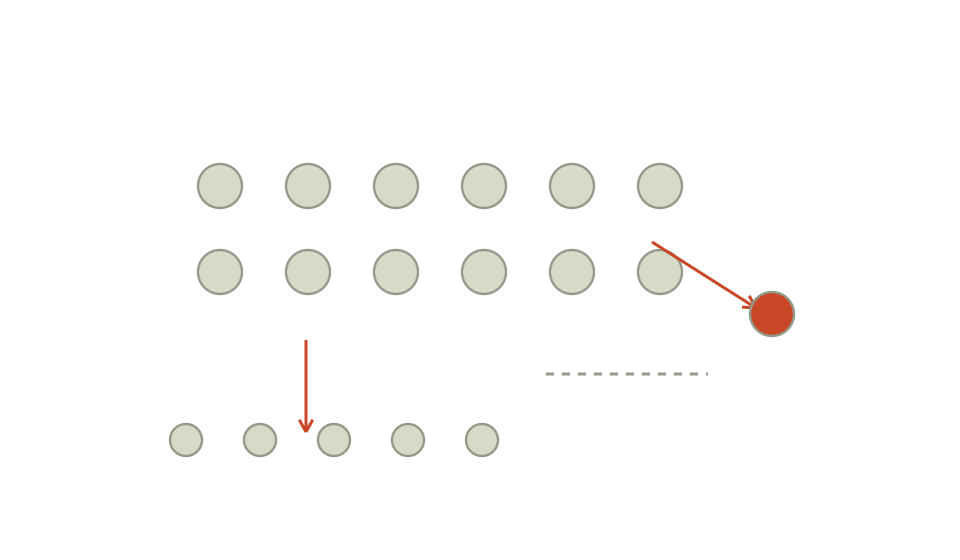
Fictional scenario: a service begins a month with 200 active subscribers. Ten from that starting group leave: six cancel and four become inactive after unresolved payment failures. Under this declared definition, customer churn is 10 divided by 200, or 5%. New customers are reported separately.
Two cancellations mention moving home; two mention a completed repair need; two mention difficulty arranging visits. Those invented reason codes guide follow up, but do not establish causes. Payment failures receive a separate operational review.
The worked example presents exits as distinct routes rather than one red total. The design response differs by route: clarify coverage and scheduling, offer a recoverable payment process and preserve an understandable exit for people whose need has ended.

03 / BELOW THE SURFACE
Below the surface: retaining an account can conceal lost trust
A churn measure can improve when people find it harder to leave.
DEFINITION
What exact event counts as churn?
Separate inactivity, cancellation and revenue.
REASON
What do we know beyond the reason code?
Keep explanation distinct from assumption.
CHOICE
Can someone leave without avoidable friction?
Check retention against trust and effort.
If cancellation requires a phone call during restricted hours, recorded departures may fall while the service has become worse. People may instead stop paying, complain or leave an account dormant. A retention intervention can change the measurement path rather than the underlying relationship.
Before testing an intervention, write a customer centred success condition: continued use is voluntary and still provides value. Pair retention with complaints, unresolved payment, exit completion and qualitative accounts as appropriate. An active account is not evidence of an active choice.
This is an editorial challenge to the interpretation, not a validated retention model. Ask what a person must do to express that the relationship should end. If that action is obstructed, the churn number is a poor summary of whether the service deserves continued use.
Churn Analysis companion worksheet
The original companion separates loss definitions, lifecycle stages and departure evidence. Page two documents a response and the customer outcome that would justify it. Calculate rates in the source system or spreadsheet and keep that system’s convention visible.


Practical tips
Reconcile lifecycle events before interpreting a trend.
Record legitimate end of need as a distinct situation.
Keep loss of customers separate from loss of revenue.
Common mistakes
Calling every inactive person churned.
Using new signups to dilute a fixed starting population rate.
Making cancellation difficult and interpreting fewer exits as greater loyalty.
What you’ll get
A defined measure of loss and a more specific account of departure. Use it to choose an intervention that restores value or supports a clean exit, then review the consequences beyond retained accounts.