
01 / UNDERSTAND
What is a RACI matrix?
A RACI matrix assigns Responsible, Accountable, Consulted and Informed involvement to activities or deliverables. Activities sit on one axis and roles on the other. The distinction between doing the work and owning its completion is central.
Responsible roles perform the work. The accountable role answers for the outcome. Consulted roles contribute input; informed roles receive updates. The matrix cannot create authority or capacity by itself.
Why use RACI Matrix?
Teams can share an objective while holding incompatible expectations about who decides, contributes and acts. A RACI offers an arrangement to negotiate before a handover or approval.
One accountable owner per activity keeps ownership clear in this guide’s convention. Several responsible contributors may be appropriate if their work is identifiable. Consultation is not an unlimited veto; being informed does not constitute a delivery commitment.
When to use it
USE IT WHEN
Several teams must deliver a service change and handover ownership is unclear.
Activities repeatedly stall because approval or consultation expectations differ.
A project needs explicit involvement rules before implementation or a pilot.
When to choose another method
Use Process Mapping first if the activities and their sequence are unclear.
Use Stakeholder Map to identify affected roles before assigning their involvement.
Use Stakeholder Interviews when authority or responsibilities are contested.
What you’ll need
Bring defined activities and completion criteria. Include people authorised to agree ownership alongside those doing the work. Make current agreements and constraints available. Use role names, then identify their holders and deputies. Agree what R, A, C and I mean locally before entering letters.
The elements of a RACI matrix
Keep the elements that help answer your question and support a decision.
Concrete work or decisions with an observable completion condition.
Distinct responsibilities rather than a mixture of individuals and whole organisations.
Who performs the work and contributes directly to its completion.
One role answerable for the outcome and able to resolve or escalate delivery issues.
Whose input is required before the work or decision is completed.
Who needs an update, at what event and through which channel.
Confirmation of authority, capacity, timing and how exceptions will be handled.
02 / PUT IT INTO PRACTICE
How to build a RACI matrix
Keep evidence and assumptions distinct. Revisit your work when new information changes your understanding.
01
Define the activities
List the work and decisions at a consistent level. Include completion criteria so a row such as launch does not hide several different approvals.
Separate approving, publishing and staffing activities.
02
Name the roles
Identify the roles needed to perform, authorise or use the work. Resolve ambiguous labels before constructing the grid.
Distinguish service owner from communications lead.
03
Assign R and A
Identify who does the work and one accountable owner for every row. A person may hold both roles when that arrangement matches real authority.
Support writes; the owner answers for suitability.
04
Add C and I
Ask whose input is needed before completion and who needs to know afterwards. Specify the subject of consultation and the event that triggers information.
Consult on access routes; inform staff after approval.
05
Check rows and columns
Review each row for missing ownership or competing A assignments. Review each role’s column for unrealistic workload and excessive dependencies.
Check whether smaller decisions can be delegated.
06
Test an exception
Walk a realistic blockage and ask who can act, who must contribute and when escalation happens. Resolve gaps in authority rather than just changing letters.
Who can delay launch or narrow the service?
07
Agree and maintain
Confirm the arrangement with the affected roles, including consultation timing and capacity. Date the matrix and revisit it when the scope or staffing changes.
Review ownership after the pilot and staffing changes.
Example: launching a library collection service
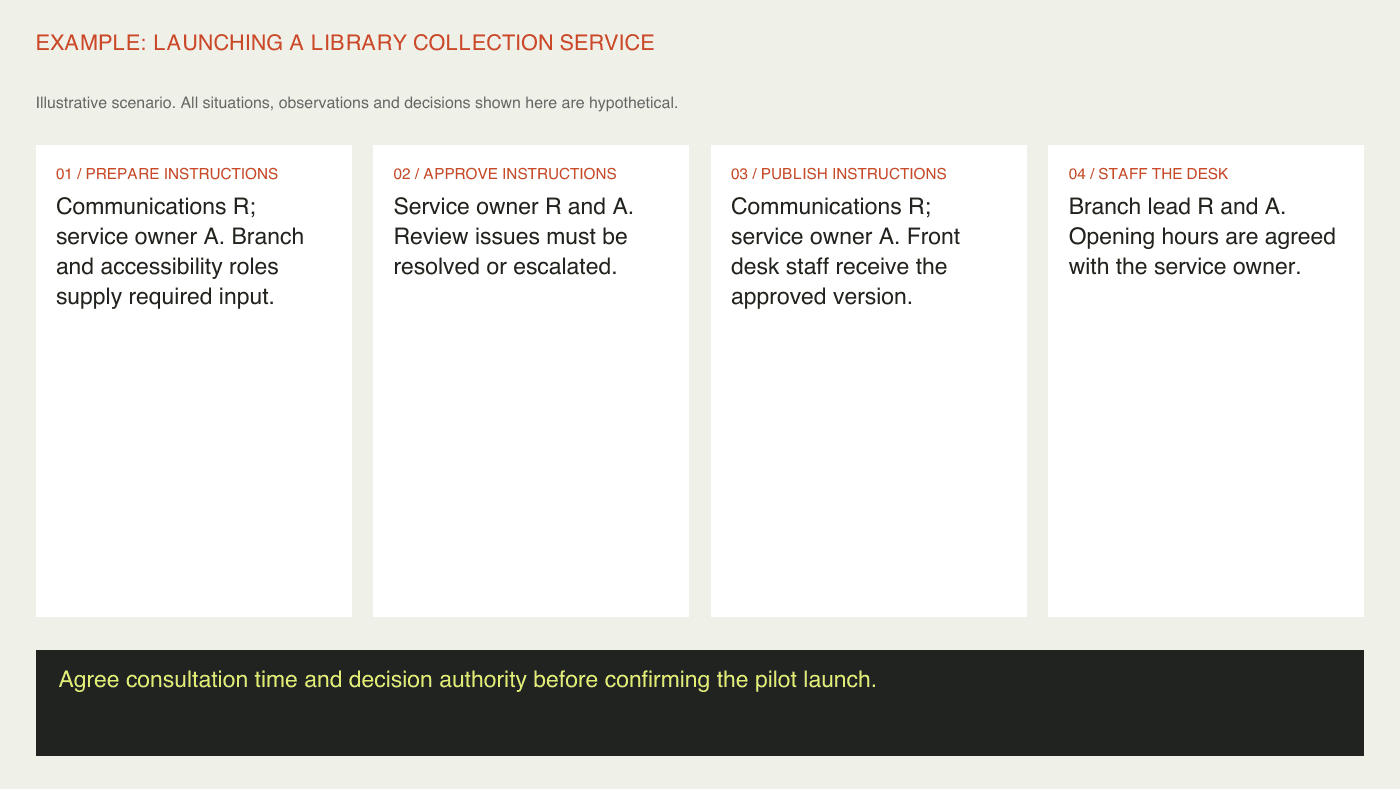
Fictional scenario: a library plans a new collection service. The pilot involves a service owner, a branch lead, a communications lead and an accessibility specialist. For preparing collection instructions, communications is R, the service owner is A, the branch lead and accessibility specialist are C, and front desk staff are I after approval.
For staffing the collection desk, the branch lead is R and A, while the service owner is C on the opening hours commitment. Reviewing a delayed instruction draft exposes a problem: consultation is expected, but nobody has reserved time for it. The specialist is listed as C while the schedule assumes immediate availability.
The team would agree a review window, the questions requiring input and an escalation route for unresolved issues. It would then record separate ownership for publishing instructions. The matrix would clarify commitments without pretending that adding a letter creates staff time. This example is invented to demonstrate RACI, not a reported library project.
03 / BELOW THE SURFACE
Below the surface: accountability must be backed by authority
A clear letter can conceal an impossible commitment.
AUTHORITY
What can the accountable role decide?
Name the practical limits and the route beyond them.
CONSULTATION
What input is needed, and by when?
Agree a review window and how unresolved input is handled.
CAPACITY
Can the responsible role deliver this commitment?
Check workload and dependencies with the people doing the work.
An accountable role may be expected to deliver an outcome while lacking control over a critical dependency. Ask what the owner can actually decide. Can they allocate effort, change scope, stop release or obtain a timely decision from someone who can? If the answer is no, the matrix has documented exposure rather than resolved it.
This tension becomes sharper across organisations. An external partner may perform an activity without accepting the same completion conditions or escalation timetable. Write the interface agreement alongside the RACI instead of assuming the grid overrides a contract or governance structure.
The original extension in this guide is an authority check for critical rows: decision available, decision limit and escalation route. Negotiate capacity as well as ownership. Otherwise the matrix can distribute blame efficiently while leaving the work no easier to complete.
RACI Matrix companion worksheet
The original two page Design Iceberg companion worksheet records roles by activity in six panels on page one. Transfer assignments to a matrix for larger scopes. Page two reviews authority, consultation, workload and exceptions.


Practical tips
Give every activity a clear completion criterion.
Leave unnecessary cells blank and confirm assignments with the people named.
Common mistakes
Assigning an accountable owner who cannot influence the outcome or escalate a blockage.
Using C to mean anyone who might have an opinion without specifying required input.
Publishing the grid as a permanent answer while scope, staffing or authority changes.
What you’ll get
A RACI should produce an accepted working agreement about delivery and involvement. Carry unresolved authority or capacity into a decision with the relevant sponsor, and keep the matrix connected to actual activities rather than treating it as a standalone governance solution.