01 / UNDERSTAND
What is bodystorming?
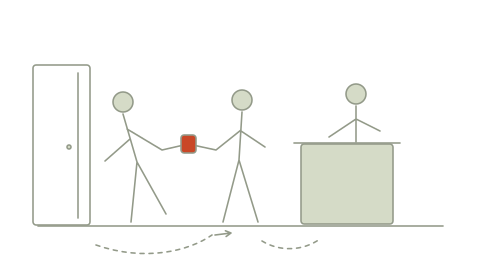
Bodystorming explores ideas through physical enactment in a relevant setting. People move through an activity, handle objects and alter the arrangement. The environment, or a meaningfully similar one, supplies constraints and opportunities.
Role Play focuses on enacted roles and interactions and can use an abstract room. Bodystorming specifically uses bodies, objects and situated conditions as design material. The methods overlap, but acting alone does not establish contextual evidence.
Why use Bodystorming?
An idea can sound workable until someone must carry an object, read a sign and communicate simultaneously. Physical exploration reveals questions about reach, movement, visibility and interruptions while arrangements remain inexpensive to change.
Enactment generates questions as well as ideas. A designer’s rehearsal does not establish user experience. Connect it with observation and participant accounts to distinguish physical constraints from assumptions introduced by the team.
When to use it
USE IT WHEN
A service or product depends on movement, objects or interactions in a physical setting.
A concept needs early exploration of spatial arrangement or simultaneous actions.
A team has research to ground a scenario and can access a safe, relevant location.
When to choose another method
Use Contextual Inquiry first when you need to understand how the activity currently happens.
Use Role Play when the main question concerns dialogue or responsibilities rather than physical context.
Use Usability Testing next when a defined interaction is ready for evaluation with intended users.
What you’ll need
Ground a bounded activity in research. Obtain permission to use the setting without disruption. Bring lightweight props and a note taker. Explain consent and stopping choices, with accessible ways to enact, observe or direct. Never require unsafe actions or simulated disability; consult people with relevant lived experience instead.
What a bodystorming session needs
Keep the elements that help answer your question and support a decision.
The activity, goal and contextual conditions supported by prior research.
A real or meaningfully similar place, with its differences recorded.
Participants, facilitator and observers with clear, voluntary roles.
Simple objects that make the proposed interaction physically explorable.
Changes to arrangement, sequence or interaction explored during enactment.
What was observed, what was assumed and what still needs user research.
02 / PUT IT INTO PRACTICE
How to run bodystorming
Keep evidence and assumptions distinct. Revisit your work when new information changes your understanding.
01
Frame the question
Select a concrete activity and identify the uncertainty physical exploration can address. Bring an observation or participant account to ground the scenario.
Explore placing books while finding a membership card.
02
Choose the setting
Use the actual place when possible and appropriate, or select a similar accessible setting. Record differences that could affect movement, visibility or interaction.
An empty branch does not reproduce busy interruptions.
03
Agree participation
Explain the activity and stopping conditions. Invite people to choose how they contribute, including observing or directing. Obtain separate consent for recording.
Participants can direct a handover without lifting props.
04
Arrange simple props
Represent the necessary objects and touchpoints with enough realism for the question. Check clear routes and safe handling before enactment.
Use lightweight book substitutes and clear routes.
05
Enact the baseline
Move through the activity once without coaching it towards success. Observe actions, pauses and improvisations. Record observations separately from the team’s explanations.
Observe where books go before the card is found.
06
Explore a variation
Change one relevant feature and enact again. Invite participants to propose arrangements. Compare the interaction rather than rating acting performance.
Try a holding surface beside the return desk.
07
Debrief and verify
Ask what felt different, what depended on the setting and what remains speculative. Choose a concept to refine and a question to investigate with intended users.
Check with borrowers and staff during ordinary operation.
Example: placing returned books at a library desk
Fictional scenario: a library team is exploring a return desk concept. Its invented research brief describes borrowers arriving with books and belongings while needing to locate a membership card. Staff and volunteers enact the sequence in a quiet branch using lightweight props.
One participant puts the books on an unmarked corner while searching a bag. The team tries a labelled holding surface beside the desk, then changes the label and its position. This gives the group concrete questions about visibility, reach and whether staff might mistake books on that surface for completed returns.
The team would carry the idea into a review with intended borrowers and staff, including people with relevant access needs. It would also observe ordinary operations before deciding where the surface belongs. The quiet rehearsal cannot establish behaviour during queues or demonstrate accessibility for everyone. This scenario is illustrative and reports no real participants or study findings.

03 / BELOW THE SURFACE
Below the surface: a fluent rehearsal can conceal design knowledge
People who know the concept often supply instructions that its future users will not have.
BODY AND OBJECTS
Which simultaneous actions make this difficult?
Describe the observed interaction without attributing motives.
PERFORMER KNOWLEDGE
What help did the team supply?
Record instructions, anticipation and improvisation that enabled success.
CONTEXT LIMIT
Which conditions were absent or changed?
Decide what requires observation or research rather than reenactment.
A designer can anticipate the next action, recognise an abstract prop and quietly repair a gap in the sequence. Watch for knowledge supplied by the performers. If somebody explains the holding surface before it is used, the rehearsal has explored an instructed interaction. Record that help rather than treating the smooth sequence as evidence of intuitive use.
Another limit comes from the setting. A quiet room can reveal a reach problem while concealing contested space or interruptions. Greater realism is not always appropriate or safe; some conditions should be investigated through observation and participant accounts instead of recreated.
The original review extension in this guide asks which contextual conditions mattered and which the session could not reproduce. Keep physical discovery separate from claims about users. An awkward action can inform a design change immediately, while conclusions about acceptance, inclusion or reliability need additional evidence.
Bodystorming companion worksheet
The original two page Design Iceberg companion worksheet plans situated enactment on page one. Page two compares variations, performer knowledge and context limits, then defines further research. It does not validate accessibility.


Practical tips
Reproduce the physical feature your question depends on with simple props.
After each variation, separate observed actions from their interpretation.
Common mistakes
Calling an office role rehearsal situated evidence without checking the relevance of the setting.
Interpreting designers’ smooth performance as proof that intended users will understand the concept.
Requiring uncomfortable, unsafe or inaccessible actions to make the session seem realistic.
What you’ll get
Bodystorming produces embodied design possibilities with explicit limits. Carry a promising variation and its unresolved contextual question into user research or prototyping. The record should explain what physical exploration revealed and what the team still needs to learn.